
You’re getting traffic. Your Google Analytics graph is going up and to the right. But your phone isn’t ringing, and your inbox isn’t filling up with enquiries.
That’s not an SEO problem. It’s a targeting problem – and it usually comes down to one thing: you’re optimizing for the wrong kind of search.
If you run a local business, understanding the difference between local SEO and traditional SEO isn’t optional in 2026. It decides whether your marketing budget brings in browsers or buyers.
Local SEO vs SEO -The Quick Answer
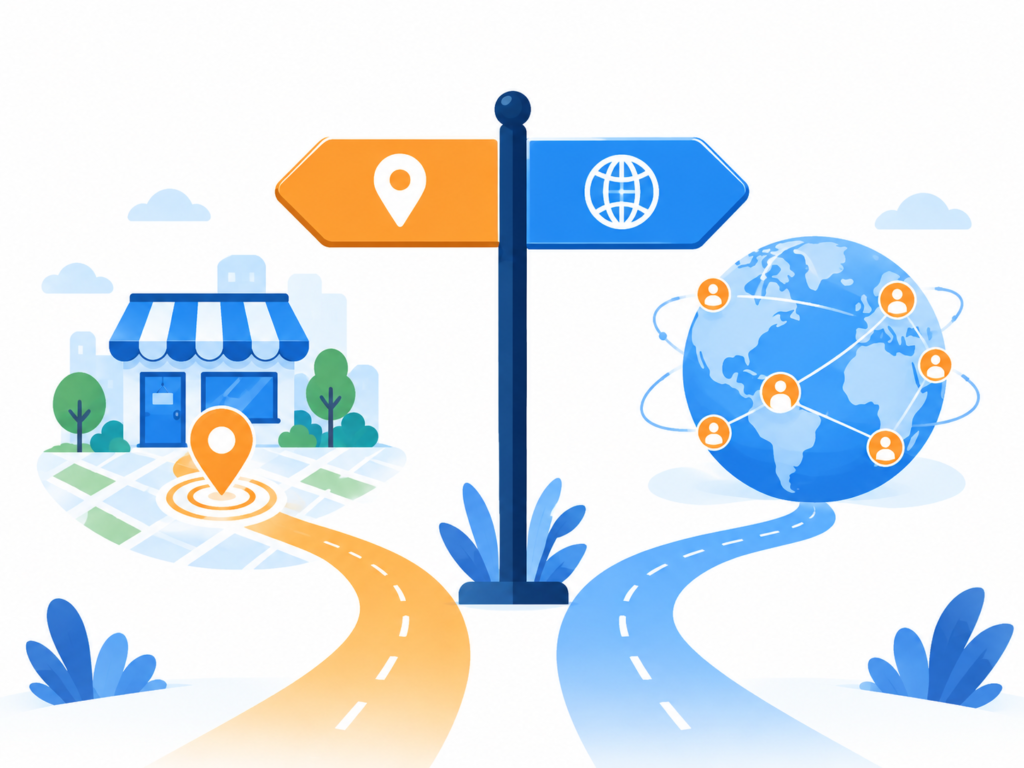
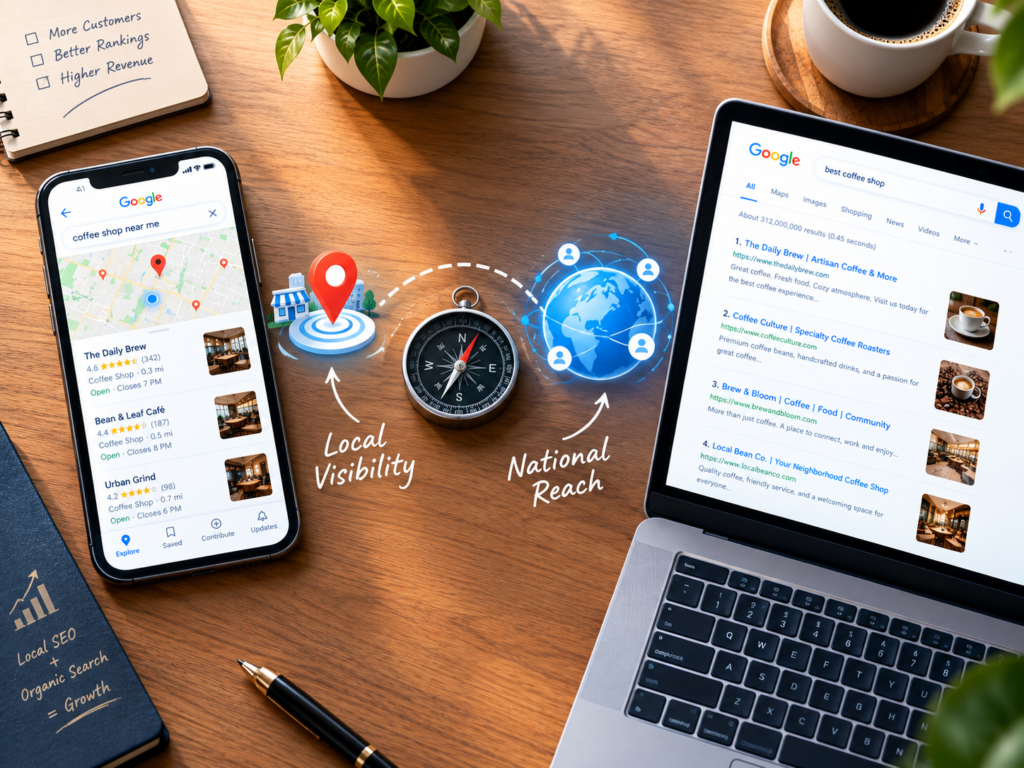
Local SEO helps your business show up when someone searches for something nearby – “electrician in Malviya Nagar” or “dentist near me.” It lives in Google Maps and the local pack, and it runs on signals like your Google Business Profile, reviews, and location consistency.
SEO (also called traditional or organic SEO) helps your website rank in the regular Google results for broader, often non-local searches – “best CRM for small teams” or “how to reduce customer churn.” It runs on content depth, site structure, and backlinks.
The short version: local SEO gets you found by people who are ready to visit or call today. SEO gets you found by people who are still researching, wherever they are.
Both matter. They solve different problems.
Local SEO vs SEO: Side-by-Side Comparison
| Factor | Local SEO | Traditional SEO |
| Where you rank | Google Maps / Local Pack | Organic search results |
| Search intent | “Near me,” ready to act now | Research, comparison, education |
| Main ranking signals | Proximity, GBP completeness, reviews, citations | Content quality, backlinks, site authority |
| Competition | Nearby businesses only | Regional, national, or global players |
| Best suited for | Clinics, salons, contractors, single-location stores | SaaS, ecommerce, multi-city or content-led brands |
| What you measure | Calls, direction requests, bookings | Organic traffic, lead quality, pipeline |
| Typical timeline | 4-10 weeks for early movement | 3–6+ months for real authority gains |
If your business has a physical location or a defined service area, local SEO delivers value fastest. If your customers could be anywhere in the country, traditional SEO is where the real ROI lives.
The Three Signals That Actually Decide Local Rankings
Every local SEO conversation eventually comes back to the same three signals. Get these right and most of the “why aren’t we ranking” questions answer themselves.
Proximity – how close your business is to the person searching. You can’t fake this, but you can influence it by setting accurate service areas and location data on your Google Business Profile.
Relevance – does your listing and website actually match what was searched? A dermatology clinic categorized simply as “Doctor” with no service details loses to a competitor who’s specific about “skin allergy treatment” or “acne clinic.”
Prominence – your reputation across the web. Review volume, review recency, citations, and backlinks all feed this. It’s the slowest signal to build and the hardest to fake, which is exactly why it separates serious local players from businesses that set up a listing once and forgot about it.
A business that nails proximity and relevance but ignores prominence will plateau. A business strong on all three usually owns the local pack in its category.
The Angle Most 2026 Guides Are Missing: AI Search
Here’s what’s changing fast and what most local SEO articles still gloss over – your customers aren’t only searching on Google anymore. They’re asking ChatGPT, Gemini, and Google’s AI Overviews questions like “best dentist near Malviya Nagar” or “which digital marketing agency should I hire in Jaipur.”
These AI systems don’t crawl your website the way Google’s classic index does. They lean on structured, verifiable business data – your Google Business Profile, consistent citations across directories, review content, and schema markup on your site. If your business information is inconsistent (different phone numbers on different directories, an outdated address, no LocalBusiness schema), AI tools either skip you entirely or recommend a competitor with cleaner data.
What this means practically for 2026:
- Add LocalBusiness schema markup to your website, not just meta tags
- Keep your NAP (Name, Address, Phone) identical across every directory and platform, including ones you haven’t touched in years.
- Write FAQ-style content on your site that mirrors how people actually ask AI tools questions – this is what AI systems pull from when generating an answer.
- Encourage reviews that mention specific services, not just star ratings – AI models weigh descriptive, recent reviews more heavily than a bare rating.
Businesses that treat “local SEO” as only a Google Maps exercise are going to lose visibility in AI-driven search over the next year. The ones treating it as a data consistency and structured content exercise will show up in both.
Your 2026 Local SEO Action Plan (In Priority Order)
Skip the generic checklists. Here’s the order that actually moves the needle, based on what produces results first:
- Audit and fully complete your Google Business Profile – every category, service, attribute, and photo. An incomplete profile is the single biggest reason local businesses stay invisible.
- Fix NAP inconsistencies across your website, GBP, and every directory you’re listed on. One mismatched phone number can quietly cap your rankings.
- Add LocalBusiness schema to your homepage and location pages so both Google and AI tools can read your business data correctly.
- Build a review system, not a review request. Ask consistently, respond to every review, and prompt customers to mention the specific service they used.
- Create genuine location pages – one per area you actually serve, with real details about that area, not a template with the city name swapped in.
- Write FAQ content in natural language that matches how people ask questions to AI assistants, not just how they type into Google.
- Track calls, direction requests, and form fills – not just impressions. Rankings without conversions mean something upstream is broken.
Do these in order. Most businesses see the first movement from steps 1–2 alone, often within a few weeks.
Which Strategy Fits Your Business? Real Scenarios
A single-location clinic in Jaipur -Local SEO, no question. Patients aren’t traveling across the state for a routine check-up. GBP optimization, reviews, and location-specific content will outperform any national content strategy.
A multi-location retail chain across Jaipur, Delhi NCR, and Mohali – Both, run together. Each location needs its own optimized GBP listing and location page, while a shared blog and category structure builds overall domain authority.
A SaaS company selling to businesses across India – Traditional SEO. Geography barely matters here; content depth, technical SEO, and backlinks from relevant industry sites will do the heavy lifting.
An ecommerce brand with two physical stores – Hybrid. National SEO carries product and category page traffic, while local pages support in-store visibility and “buy online, pick up nearby” searches.
A real estate agency serving one city – Local SEO first, with content marketing layered in later for buyers still in the research phase before they’re ready to talk to an agent.
Common Mistakes That Quietly Kill Local Rankings
Treating your Google Business Profile as a set-and-forget listing. It needs updates, new photos, and fresh posts regularly – a stale profile signals inactivity to Google.
Ignoring citation consistency. A business with five different address formats across ten directories tells Google it can’t trust the data, and rankings suffer accordingly.
Writing one generic “Services” page for multiple locations. Duplicate content with a city name swapped doesn’t help you rank for that city – it just dilutes your own pages against each other.
Chasing reviews in bursts. A flood of reviews in one month followed by silence for a year looks unnatural. Steady, ongoing review activity is what actually builds trust signals over time.
Skipping structured data entirely. Without schema markup, you’re relying entirely on unstructured text for both Google and AI tools to understand your business – and you’re leaving visibility on the table that a competitor with proper markup will pick up instead.
FAQs
What is the main difference between local SEO and SEO?
Local SEO targets Google Maps and local pack rankings for nearby, high-intent searches. Traditional SEO targets the main organic results for broader, often research-stage searches. One brings in customers ready to act now; the other builds long-term visibility across a wider audience.
Do I need local SEO if I already have a website ranking on Google?
Ranking organically doesn’t guarantee visibility in the Map Pack – they run on different signals. A business can rank well in regular search results and still be invisible to nearby customers searching “near me,” which is exactly where local SEO closes the gap.
Ready to Fix Your Local Visibility?
If you’re getting traffic but not enquiries, the fix usually isn’t more content – it’s aligning your strategy with how your actual customers search, on Google and increasingly on AI tools too.
Ace Web Experts has spent 15+ years helping businesses across Jaipur, Delhi NCR, and Mohali turn search visibility into real bookings, calls, and revenue – across clinics, real estate, education, ecommerce, and professional services.